Every collection has its own rhythm. Find a wine cooler that keeps pace with yours.
Perhaps you want a few bottles ready for dinner. Perhaps you want to give your finest vintages the time they deserve. Choosing a wine cooler starts with understanding how you enjoy wine and where you will look after it.
This guide helps you compare with confidence: which type suits your needs, how many bottles will actually fit, when two zones make sense and what to check before installation. Clear advice, backed by the specialist support of Vinoteca.es.
Which wine cooler should you choose? Start with these five decisions
- Purpose: storing wine for regular drinking, ageing it for years or keeping it at serving temperature.
- Installation: freestanding, undercounter, built into a tall unit or finished with a panel to match your kitchen.
- Real capacity: your current bottles, their shapes and sizes, and space for future purchases.
- Temperatures: one zone for one setting; two if you want to maintain two different temperatures at the same time.
- Environment and convenience: room temperature, noise, energy use and access to your bottles.
The best choice fits your home and your habits. Additional features are worthwhile when they meet a specific need.
1. Decide what you want to do with your wine
Store the bottles you will enjoy soon
If you buy wine for the coming weeks or months, look for a stable environment, protected from light and suitable for the wines you own. A wine cooler helps you organise your collection and maintain a chosen temperature within its operating range.
Start with your routine: what you drink, how much you buy at a time and how often you open a bottle. These answers are more useful than choosing by appearance or the number of zones alone.
Store and age wine over several years
Long-term ageing calls for a cabinet designed for that purpose. Alongside temperature stability, consider humidity management, protection from light, vibration reduction and air circulation.
Around 12 °C is a common reference temperature for ageing. Reds and whites can share that temperature and be brought to their ideal serving temperature before opening. Ageing potential depends on the wine: a wine cabinet cannot turn every bottle into a wine suitable for long-term cellaring.
Keep wine ready to serve
If your priority is to open and enjoy, choose according to the temperatures at which you serve your wines. One zone may be enough if you mainly drink one style. Two zones are convenient when you want chilled whites and reds at a warmer temperature ready at the same time.
To combine ageing and serving: check that the appliance is designed for both uses and that each compartment has the temperature range and capacity you need. Having two zones does not, on its own, establish suitability for long-term ageing.

2. Choose one, two or more zones to suit your needs
A zone is a compartment with its own temperature setting. Two zones allow you to maintain two different settings, subject to the manufacturer's requirements. Two doors do not necessarily mean two zones, and two zones do not imply two compressors.
| Your priority | Where to start | What to check |
|---|---|---|
| Cellaring a collection as it develops | One zone in a cabinet suitable for ageing | Stability, humidity and protection for your wine |
| Mainly serving one style of wine | One zone | Whether it can reach your chosen temperature in your room |
| Keeping whites and reds ready together | Two zones | The range and capacity of each compartment |
| Combining several temperatures and uses | Two or three zones, or a multi-temperature cabinet | How each space is regulated and what it is designed for |
Before choosing two zones, check how many bottles fit in each one. Adequate total capacity may still leave too little room for your whites if the cooler compartment is small. Also check whether one zone must be colder than the other, or whether a specified temperature difference is required.
With multi-temperature models, check whether there are independent compartments or a temperature gradient between levels. The name alone does not explain how the cabinet works.
Compare single-zone wine coolers, dual-zone wine coolers and multi-temperature wine coolers according to what you need to keep ready at the same time.
Serving temperatures: a guide to help you choose
| Wine style | Indicative temperature |
|---|---|
| Sparkling wines | 6–10 °C |
| Light whites and rosés | 7–10 °C |
| Fuller-bodied or oak-aged whites | 10–13 °C |
| Light reds | 12–14 °C |
| Full-bodied reds | 15–18 °C |
The wine's style, the producer's advice and your own taste will help you fine-tune serving temperature. A red served at “room temperature” may be too warm in summer. Bottles also need time to reach the cooler's setting: a wine cooler does not chill them instantly.
3. Choose the installation type before the model
A wine cooler needs to release the heat it removes from inside. This is why fitting the dimensions of a recess does not mean an appliance can be installed in it.
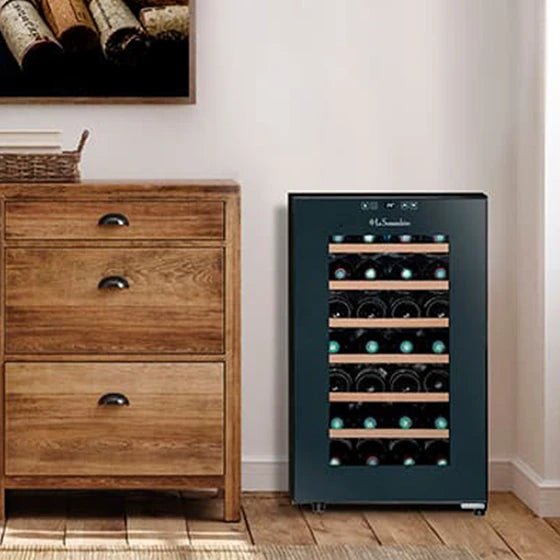
Freestanding: a place of its own in your home
This is an option for a living room, dining room or another suitable space. Leave the side, rear and top clearances stated in the manual. Do not enclose it in cabinetry unless the manufacturer expressly permits that installation.
Explore freestanding wine coolers if you want an appliance that stands independently of your furniture.
Undercounter: part of everyday kitchen life
Choose a model designed to be built in beneath a worktop and follow its installation plan. Many models release heat through a front grille: the plinth and surrounding cabinetry must leave the specified airflow path clear.
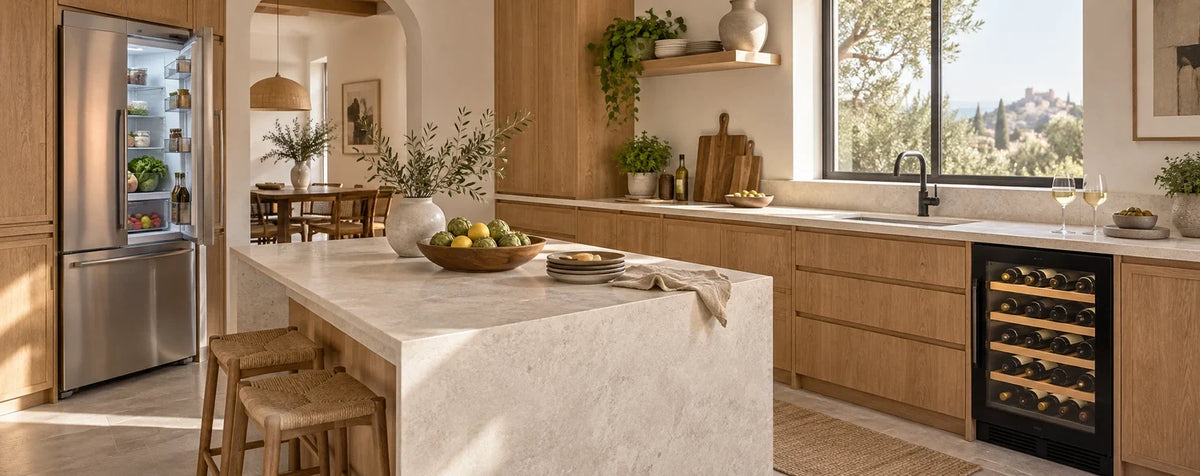
Check adjustable height, depth including the handle, socket position and door opening next to walls or cupboards. Start with our undercounter wine coolers.
Built into a tall unit: convenient access at a different height
This requires a model suitable for that position and cabinetry designed to support the fully loaded appliance. Air inlets and outlets must follow the manufacturer's plan; you cannot assume the requirements are the same as those of another appliance.
Browse built-in column wine coolers before deciding on the dimensions of your kitchen recess.
Panel-ready: a finish to match your cabinetry
A panel-ready wine cooler accepts a decorative front or frame compatible with its design. “Panel-ready” describes this finishing option; you still need to check the permitted installation type. Verify panel dimensions and maximum weight, hinges, handle and ventilation.
For a seamless look, explore our panel-ready wine coolers and choose the appliance before commissioning the cabinetry.

Measure more than width, height and depth
- The open door: check the opening angle needed to pull out the shelves and allow room for the handle.
- The delivery route: doors, corridors, lifts and stairs, allowing for packaging where relevant.
- The supporting surface: stable, level and able to carry the weight of the appliance and bottles.
- The power connection: an accessible socket positioned without interfering with depth or ventilation.
4. Work out the capacity you will actually use
Stated capacity is usually calculated using standard 75 cl Bordeaux bottles in a particular arrangement. It does not mean the same number of every 75 cl bottle will fit.
Burgundy bottles, many sparkling wine bottles and some special formats take up more space. Magnums need compatible internal dimensions. Adding shelves or prioritising individual access can also reduce the bottle count compared with the maximum loading arrangement.
Make a simple estimate
- Count the most bottles you normally keep: include case purchases and bottles set aside for later.
- Separate the formats: identify how many are wider, longer or larger in volume.
- Allow for planned purchases: leave a reasonable margin for your interest in wine to grow.
- Check the loading plan: confirm that the layout lets you store and retrieve your bottles comfortably.
For example: if you usually keep 24 bottles and buy cases of 6, you will need usable space for around 30 after a purchase. If some are sparkling wines, do not assume a cooler rated for 30 Bordeaux bottles will be enough.

To narrow your search, explore collections for up to 20 bottles, 20 to 40 bottles, 40 to 80 bottles, 80 to 150 bottles or more than 150 bottles. Then check the usable capacity for your own collection.
5. Check how warm and cold the room gets
The internal temperature setting range and the permitted ambient temperature are two different things. Being able to select 12 °C does not mean the appliance can maintain it in any room.
The climate class indicates the ambient conditions the appliance is designed for. Check the permitted minimum and maximum temperatures against those in your room throughout the year. A hot kitchen, a garage or an unheated holiday home needs particular attention.
Can it go in a garage or a cold room?
Only if the model supports those conditions. Some have a winter system that adds heat when needed to keep the interior within its intended operating conditions. Its limits depend on the appliance: it does not mean every wine cooler can work at an ambient temperature of 5 °C, below freezing or outdoors.
To choose confidently, note the winter minimum and summer maximum. Avoid direct sunlight and heat sources, and follow the ventilation requirements. An outdoor location requires specific manufacturer approval for that use.
6. Compare cooling, noise and energy use
Compressor or thermoelectric: consider the operating conditions
Compressor wine coolers come in a wide range of sizes and temperature ranges. They are worth considering when you need capacity or low serving temperatures, always within their specified ambient range.
Thermoelectric models can suit smaller collections in moderately warm rooms, but their cooling performance is particularly dependent on the surroundings. Having no compressor does not mean complete silence: they may have fans. It also does not mean they necessarily use less electricity.
Compare the lowest achievable temperature, ambient range, noise level and annual kWh of the specific model. The cooling technology's name is no substitute for those figures.
Noise: think about where you will hear it
For an open-plan living space or a quiet room, check the declared noise emission in dB(A) and its noise class. Between comparable appliances, a lower figure means lower declared noise emissions, but your perception also depends on start-up sounds, fans and the room's acoustics.
An appliance that is not level, or is touching surrounding furniture, can transmit vibrations. If quiet operation is a priority, tell us where it will stand and how you use the room before choosing.
Energy use: compare kWh per year
The energy label shows efficiency class, annual energy consumption and noise. Power in watts is not the same as annual energy use: the appliance's operation varies throughout the day.
Estimate the running cost
kWh/year × your electricity price per kWh = approximate annual cost.
Illustrative example: 150 kWh/year × €0.20/kWh = €30 per year, or around €2.50 per month. This is neither a current tariff nor the consumption of every wine cooler; replace both figures with those for your appliance and electricity contract. Fixed charges on your bill are excluded from this calculation.
Compare models of similar size and intended use. Room temperature, door openings, the internal setting and ventilation can cause actual consumption to differ from the label's figure.
7. Invest in features you will use
To care for a collection you are ageing
- Humidity: check how it is maintained and whether it is measured or regulated. A humidity display does not imply active control.
- Protection from light: consider a solid door or glazing with declared UV protection; avoid direct sunlight in either case.
- Vibration reduction: check the systems provided and the quality of the supporting surface. Different appliances offer different solutions.
- Internal ventilation and filter: check whether a charcoal filter is included and when it needs replacing. This is not a universal feature.
- Alarms: distinguish between an open door alert, temperature deviation alerts and other warnings; verify which ones are included.
For everyday enjoyment
Pull-out shelves make it easier to find a bottle without moving the others. Check their load limit, space for wider bottles and access with the door open. Consider adjustable lighting, door opening direction and whether the door is reversible.
If an app interests you, check its exact functions: recording your inventory, receiving alerts and adjusting the temperature are different capabilities. App compatibility does not guarantee all of them.
For bars and restaurants
Prioritise capacity per zone, restocking during service, quick access and suitability for your working routine. Also consider maintenance and after-sales support. Start with our wine coolers for hospitality and check the professional use permitted for each model.
How to allocate your budget
Start with correct installation, usable capacity, ambient range and intended use. Then decide how much value shelves, finish, connectivity or advanced ageing features add for you. Where applicable, include cabinetry, decorative panels, installation and maintenance in the total cost.
Before deciding, check delivery conditions for your location, access to the installation point and the availability of support and spare parts. This lets you compare complete proposals.
Your checklist before buying
- I have decided whether I want to store, age, serve or combine uses.
- The model supports the installation type I need.
- I have checked the recess, clearances and airflow path.
- The door can open far enough to use the shelves.
- My bottle formats fit the intended layout.
- I have enough capacity in each zone and room to grow.
- My room's ambient temperature is within the permitted range.
- I have compared noise and annual energy use.
- I have checked which features the appliance actually includes.
- I understand the delivery, initial setup and support arrangements.
A tip from our specialists: keep the measurements of your space and a photo of the bottles you use most. These are two of the most useful references when helping you choose.
Frequently asked questions about choosing a wine cooler
Do I need two zones if I have red and white wine?
Not necessarily. To store them at a shared temperature, one zone may be enough if the appliance is suitable for your intended use. Two zones are convenient when you want to maintain different serving temperatures at the same time.
Can a single-zone wine cooler be used for ageing wine?
It can if it is designed for ageing. The number of zones does not determine suitability: check temperature stability, humidity management and protection from light and vibrations, as well as the manufacturer's guidance.
Can I put a freestanding wine cooler under a worktop?
Only if the manufacturer permits that location and you can meet all its requirements. For a kitchen recess, look for a model designed to be built in. Do not cover grilles or improvise clearances.
Do built-in, integrated and panel-ready mean the same thing?
Brands do not always use these terms in the same way. Check the permitted use: undercounter or tall-unit installation, required ventilation and whether a decorative panel can be added. An integrated wine cooler does not necessarily accept a cabinet door.
Will cava, Champagne or magnum bottles fit?
That depends on their diameter and length, and on the internal layout. Check compatible shelves and the loading plan. Removing a shelf may accommodate a larger format if the manual permits it, but this changes capacity and organisation.
Do all wine coolers control humidity?
Not all provide active regulation or let you select a percentage. Some manage humidity in other ways, while others only display it. If you plan to cellar wine for years, confirm how the model works and what maintenance it needs.
Can I use it as a refrigerator for food?
Do not use it for perishable food unless it is expressly designed for that purpose. A wine cooler's temperature range and conditions may not be suitable.
Will a wine cooler preserve an open bottle indefinitely?
No. Cooling can slow changes, but it does not remove the oxygen introduced when the bottle is opened. An opened bottle needs a suitable closure or preservation system and should be consumed within a period appropriate to the wine.
Should bottles be stored on their sides?
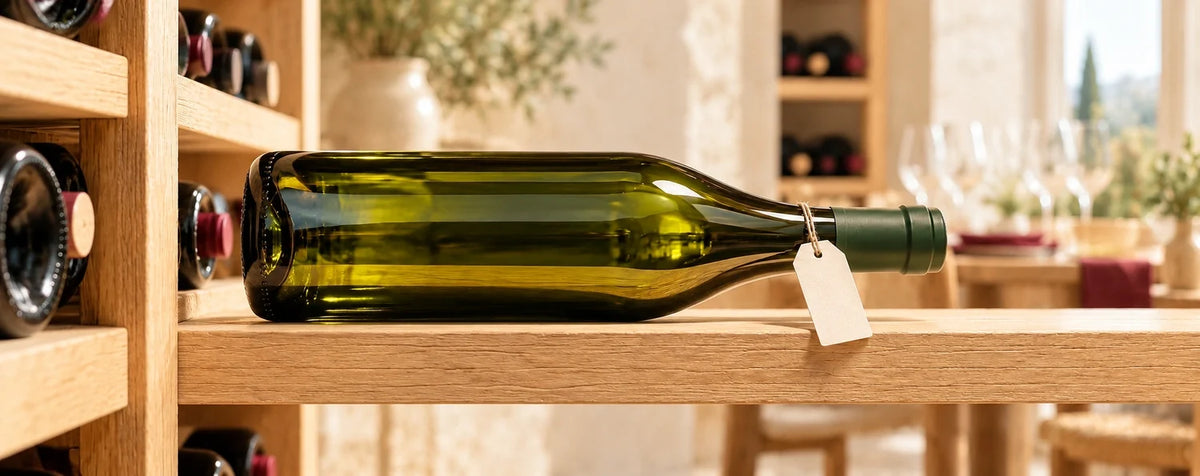
For ageing wines sealed with natural cork, horizontal storage is the usual recommendation. Screw caps do not have the same requirement. In every case, follow the position and loading arrangement specified for the shelves.
What should I do when it arrives?
Check the condition of the delivery and follow the manual for positioning, levelling and starting the appliance. Observe the resting time after transport specified by the manufacturer: there is no single period that applies to every model. Allow it to stabilise before assessing performance, and load it according to its instructions.
Give your wine the place it deserves
At Vinoteca.es, we help you match your collection's needs to the possibilities of your space. Tell us where the cooler will go, the available dimensions, how many bottles you want to keep and whether your priority is storing or serving.
Speak to our specialists: +34 917 37 91 25 · info@vinoteca.es
You can also continue with the recommendation tool below to help narrow your search.